
Subclassing in Verse
In Verse, you can create a class that extends the definition of another class by adding or modifying the fields and methods of the other class. This is often called subclassing or inheritance, because one class inherits definitions from the other class.
Let’s look at the Class Designer device as an example of subclassing. With the Class Designer device, you can create character classes for player characters that let you define the attributes and inventories specific to a character class, such as a tank or DPS (damage per second) character.
| DPS character class created with the Class Designer device | Tank character class created with the Class Designer device |
In Verse, you could create a tank class and a dps class like this:
tank := class():
    StartingShields : int
    MaxShields : int
    AllowOvershield : logic
    DamageReduction : int

dps := class():
    StartingShields : int
    MaxShields : int
    AllowOvershield : logic
Expand code Copy full snippet(11 lines long)
Because some of the fields in the two classes are the same, you can reduce duplication with a superclass that holds the shared properties and behaviors of the classes. Let’s call this superclass player_character, and make tank and dps subclasses of player_character:
|  |  |
| --- | --- |
|  | player_character := class(): |
|  | StartingShields : int |
|  | MaxShields : int |
|  | AllowOvershield : logic |
|  |  |
|  | dps := class(player_character): |
|  | MovementMultiplier : float |
|  |  |
|  | tank := class(player_character): |
|  | DamageReduction : int |
player_character := class(): StartingShields : int MaxShields : int AllowOvershield : logic dps := class(player_character): MovementMultiplier : float tank := class(player_character): DamageReduction : int
Copy full snippet(10 lines long)
Since the tank and dps classes are subclasses of player_character, they automatically inherit the fields and methods of the player_character class, so you only need to specify what’s different in this class from the superclass.
For example, the dps class only adds the Movement Multiplier field, and the tank class only adds the DamageReduction field. This setup is useful if you change the shared behaviors of the two classes later because you’ll only need to change it in the superclass.
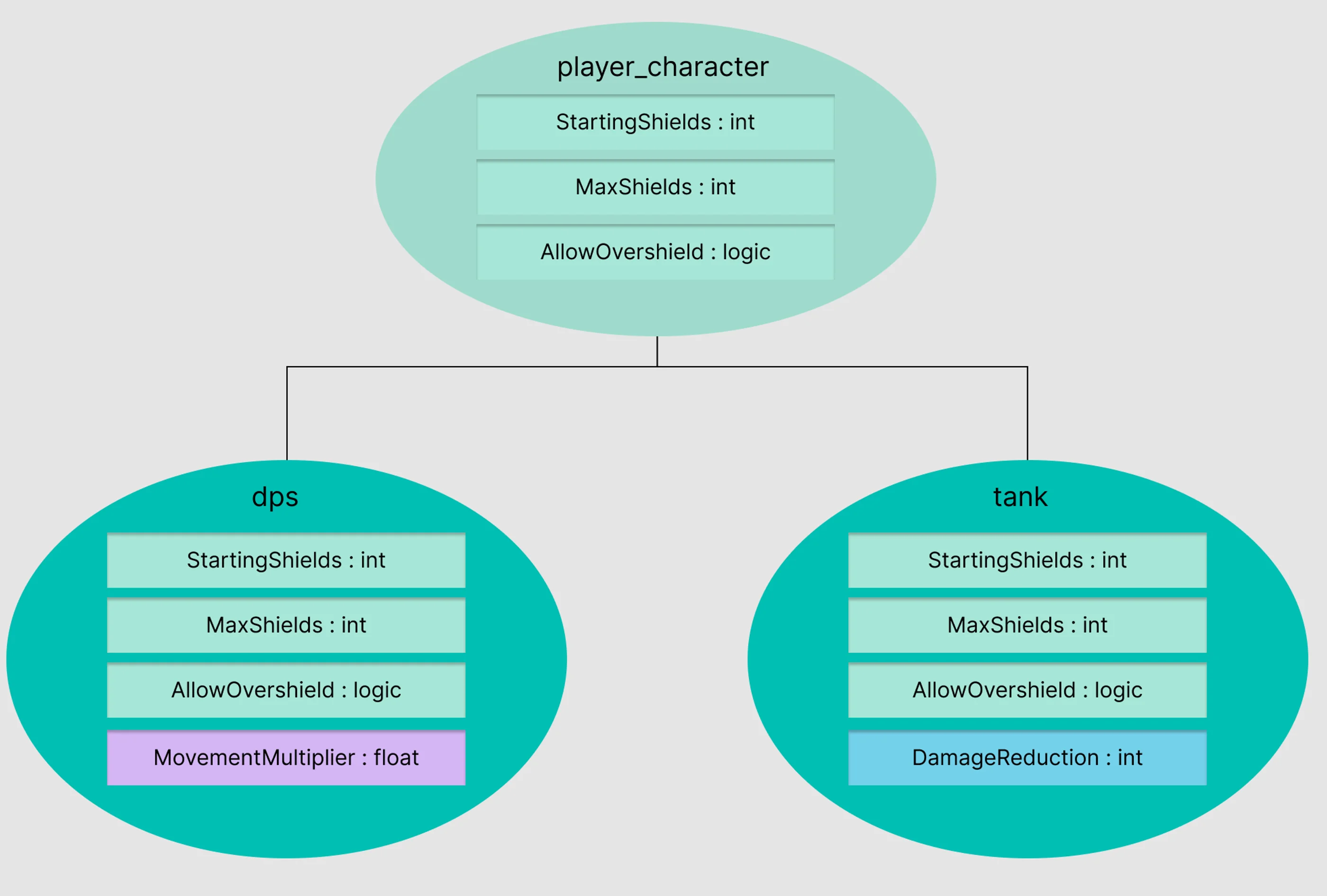
With Verse, you can add more changes to differentiate the tank and dps classes by adding methods to the subclasses.
A useful effect of subclassing is that you can use the relationship between a superclass and its subclasses. Because of inheritance, an instance of tank is a specialized player_character, and an instance of dps is a specialized player_character, which is referred to as an is-a relationship. Since tank and dps are both subclasses of the same superclass and diverge from their shared superclass, tank does not have a relationship with dps.
Override Specifier
To create instances of classes with initial values, a common practice is to have a function that generates the instances. For example:
|  |  |
| --- | --- |
|  | CreateDPSPlayerCharacter() : dps = |
|  | return dps{StartingShields := 0, MaxShields := 0, AllowOvershield := false, MovementMultiplier := 1.9} |
|  |  |
|  | CreateTankPlayerCharacter() : tank = |
|  | return tank{StartingShields := 100, MaxShields := 200, AllowOvershield := true, DamageReduction := 50} |
CreateDPSPlayerCharacter() : dps = return dps{StartingShields := 0, MaxShields := 0, AllowOvershield := false, MovementMultiplier := 1.9} CreateTankPlayerCharacter() : tank = return tank{StartingShields := 100, MaxShields := 200, AllowOvershield := true, DamageReduction := 50}
Copy full snippet(5 lines long)
The CreateTankPlayerCharacter() and CreateDPSPlayerCharacter() functions create the instances with the appropriate initial values. Alternatively, you can override the fields from the superclass and assign initial values, so you don’t need to provide so many initial values when creating an instance.
For example, the tank class from the previous section could look like this with overrides on the fields:
|  |  |
| --- | --- |
|  | tank := class(player_character): |
|  | StartingShields<override> : int = 100 |
|  | MaxShields<override> : int = 200 |
|  | AllowOvershield<override> : logic = true |
|  | DamageReduction : int = 50 |
|  |  |
|  | CreateTankPlayerCharacter() : tank = |
|  | return tank{} |
tank := class(player_character): StartingShields<override> : int = 100 MaxShields<override> : int = 200 AllowOvershield<override> : logic = true DamageReduction : int = 50 CreateTankPlayerCharacter() : tank = return tank{}
Copy full snippet(8 lines long)
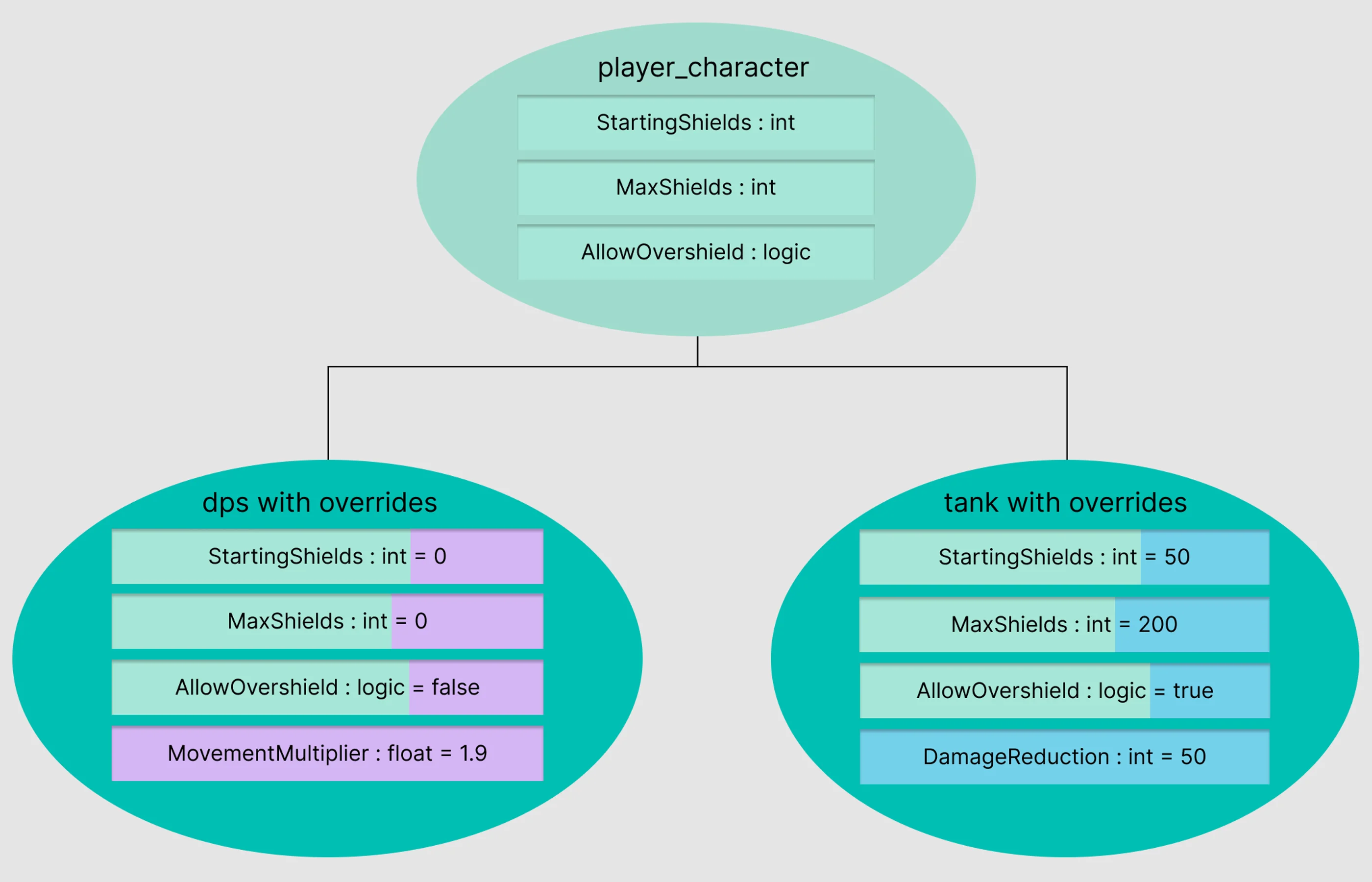
You can also override methods in the subclass, which means you can use the overriding method everywhere the overridden method can be used. This means:
- The method must accept at least any argument accepted by the overridden method, so the parameter type must be a supertype of the overridden function's parameter type.
- The method must not return a value that the overridden method couldn't have, so the return type must be a subtype of the overridden method's return type.
- The method must not have more effects than the overridden method, so the effect specifier must be a subtype of the overridden method's effect specifier.
Super
Similar to Self, you can use (super:) to access the superclass implementations of fields and methods. To be able to use (super:), the field or method must be implemented in the superclass definition.
pet := class():
    Sound : string

    Speak() : void =
        Log(Sound)

cat := class(pet):
    Sound<override> : string = "Meow"

    Speak<override>() : void =
Expand code Copy full snippet(12 lines long)
Block Expressions in a Subclass Body
Any block expressions that are in a subclass body will be executed after the block expressions specified in the superclass body. For example, in the following code, when the instance of the cat class named MrSnuffles is created, Speak() is executed first, then Purr().
pet := class():
    Speak() : void =
    ...

    block:
        Speak()

cat := class(pet):
    Purr() : void =
    ...
Expand code Copy full snippet(15 lines long)
Abstract Specifier
When a class or a class method has the abstract specifier, you cannot create an instance of the class. Abstract classes are intended to be used as a superclass with partial implementation, or as a common interface. This is useful for when it doesn’t make sense to have instances of a superclass but you don’t want to duplicate properties and behaviors across similar classes.
In the following example, because pet is an abstract concept, an instance of the pet class isn’t specific enough, but a pet cat or pet dog does make sense, so those subclasses aren’t marked as abstract.
|  |  |
| --- | --- |
|  | pet := class<abstract>(): |
|  | Speak() : void |
|  |  |
|  | cat := class(pet): |
|  | Speak() : void = |
|  | ... |
|  |  |
|  | dog := class(pet): |
|  | Speak() : void = |
|  | ... |
pet := class<abstract>(): Speak() : void cat := class(pet): Speak() : void = ... dog := class(pet): Speak() : void = ...
Copy full snippet(10 lines long)